

Ecosia, the search engine that uses 100% of its profits for the planet, provides a search experience with a positive environmental impact. Ecosia is conscious about its data sources: it aims to provide search functionality that provides clear and truthful results quickly, with links to sources and correct attribution. That’s why Ecosia partnered with Wikimedia Enterprise last year to continue providing its users with knowledge from trusted sources of information, curated and maintained by a thriving community of Wikimedians. Let’s dive into how Ecosia implemented knowledge panels, attributes its sources, and is improving search with AI.
Ecosia has been able to enrich more than 3 million search queries every day with fresh data from Wikipedia using Enterprise APIs. Access to daily snapshots ensures the information presented in Ecosia knowledge panels is always up-to-date.
Let’s dive into how Ecosia has developed its knowledge panels using Wikimedia Enterprise, what challenges they faced, and how Wikimedia Enterprise will be used to support the new future of AI-powered search results.
Collaboratively Solving Knowledge Panel Implementation Challenges
To kickstart Ecosia’s development, Wikimedia Enterprise engineers developed an interactive knowledge panel demo and tutorial, which is available for review in our article How to build a Knowledge Panel using the Enterprise APIs.
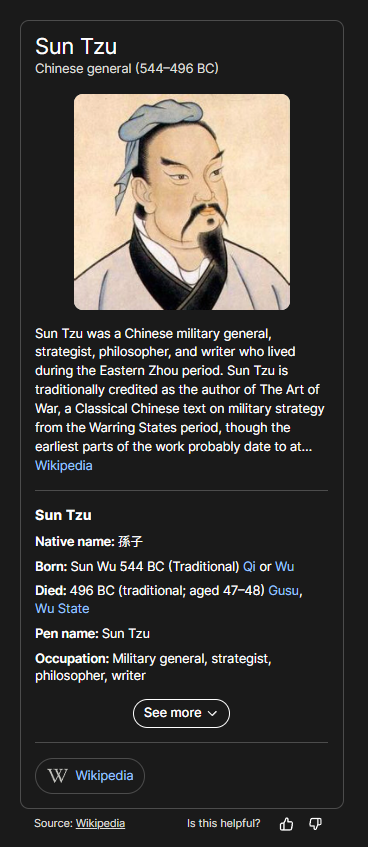
Knowledge panels improve search queries by providing helpful information in a panel next to the search results: if one wants to know more about Marie Curie, Ecosia’s knowledge panel pulls the most relevant information about her from Wikipedia, such as her name, occupation, date of birth and death, a small paragraph of text summarising who she is, and an image. This way, anyone can discover quick facts and summaries about their search query at a glance.
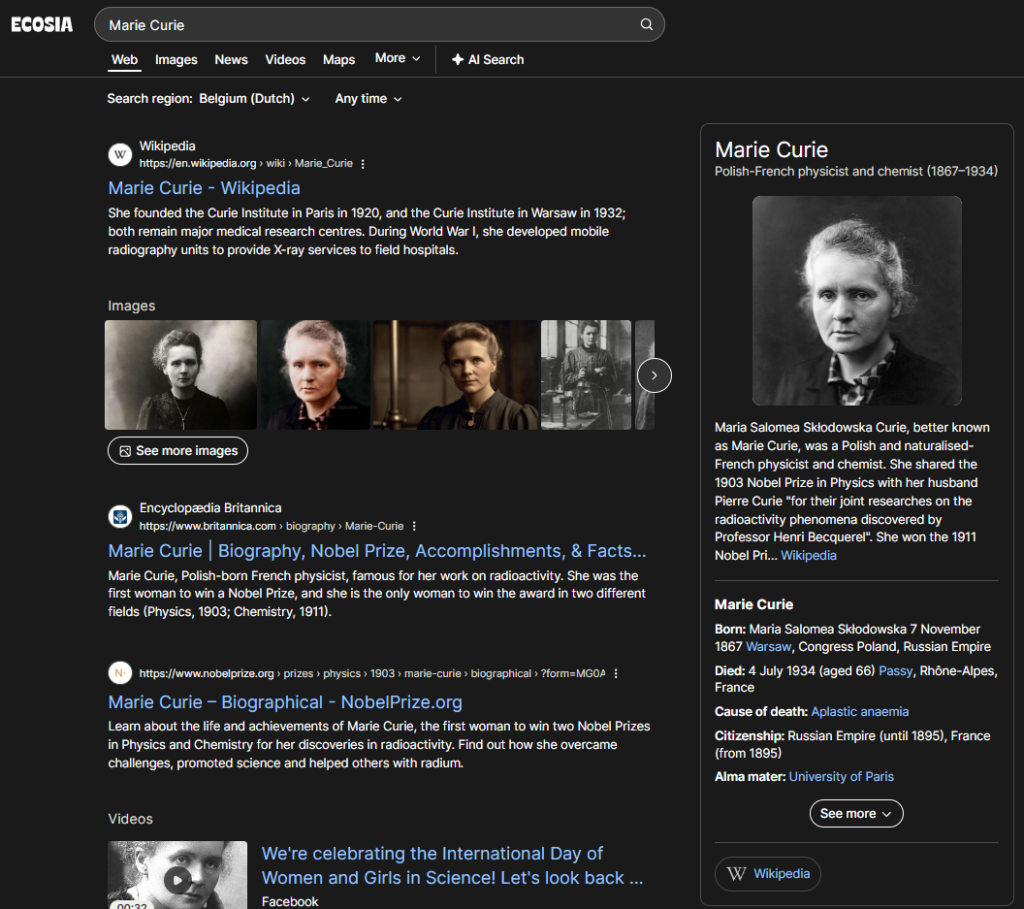
Soon after implementing the knowledge panels at Ecosia, an important issue was uncovered: the information shown in knowledge panels was quickly turning stale and being subjected to vandalism and misinformation. That initial implementation relied on ingesting data snapshots only twice a month using a free Enterprise account, meaning that if vandalism wasn’t reverted before the snapshot was created, it persisted on Ecosia’s results page for up to two weeks. This forced the Ecosia team to temporarily roll back the feature.
Partnering with Enterprise to give Ecosia the benefits of a paid account gave access to the Structured Contents in the Snapshot API. This API provides snapshots of full Wikimedia projects, updated daily. This simple but powerful change almost immediately mitigated Ecosia’s issues. It ensured that any vandalized version reverted by Wikipedia editors was reflected in Ecosia’s data within hours instead of weeks.
The Structured Contents API provides direct access to pre-parsed, well-structured Wikipedia article data, also eliminating the technical overhead and data limitations Ecosia previously faced. As Doris Höflmaier, Senior Product Manager at Ecosia, notes, the new approach was a game-changer.
“Enterprise’s pre-parsing is a huge step forward for us.”
Doris Höflmaier
Additionally, Ecosia implemented a filter based on RevertRisk, a credibility signal, to proactively identify and sideline problematic edits surfaced in some revisions before they became problematic.
With Ecosia now having access to Structured Contents snapshots, more possibilities to intelligently populate Knowledge Panels were unlocked: Structured Contents allowed Ecosia to include a short description and set of ‘quick facts’ in every knowledge panel, pulled from its pre-parsed JSON.
Ecosia’s technical workflow was transformed:
- Depending on the user query, Ecosia looks up relevant Wikipedia articles. Its internal database is updated daily using the Enterprise Snapshot API endpoint.
- Credibility signals, like the RevertRisk score, are used to filter for high-quality, reliable article revisions.
- Key article data, like title, main image, abstract, short description, and quick facts, are extracted and displayed in the knowledge panel.
Wikimedia Enterprise’s solution directly addressed Ecosia’s pain points by providing:
- Ready-to-use JSON: Each article is delivered in a clean, structured JSON object, making it easy to process and present to users in a clean UI.
- Rich Data Fields: The Structured Contents Initiative parses Wikipedia article data into separate JSON arrays for e.g. the main image, abstract, description, and parsed infoboxes, allowing for more comprehensive knowledge panels.
- Daily updates: daily updated snapshots of every Wikimedia project across multiple languages ensure the data stays fresh and relevant.
The Power of Attribution
Attributing information to its sources is crucial to building trust with users. When information from Wikipedia shows up in Ecosia search results, it is clearly linked to its source article. This enables users to employ their critical thinking skills: they can analyze the source of the information and click through to that source to learn more or gain additional context. More than 15 million monthly visits to Wikipedia come from Ecosia search result pages.
Attribution is also crucial for the continued vitality of Wikimedia’s volunteer community. A link to a Wikipedia source is a form of recognition for the work that community members put into building that knowledge. Referral traffic to Wikipedia and its sister projects ensures that people recognize Wikipedia as a trusted source, and reminds them that they can become contributors or donate to the cause! Wikimedia projects are only as good as the contribution of their global volunteers, so Ecosia also has a vested interest in fostering and caring for that community.
New ways to search, find, and learn, using AI summaries and chat
Experiments done at Ecosia and surveys of the highly competitive search engine landscape have shown that users increasingly value AI-generated content in their search results. It is, however, crucial that this AI-generated information is grounded in facts and uses verifiable sources.
Ecosia’s LLM output is (in cases where relevant) already making sure that the information it presents is based on real web search results to provide a ground truth and reliable source. To further enhance trust and transparency, Ecosia plans to utilize the internal database of structured Wikimedia data to enrich and inform the output of its AI chat. In this way, the data ingested from the Wikimedia Enterprise APIs is more relevant than ever in helping shape the future of search at Ecosia.
Building Better Search Results with knowledge from Wikimedia
Ecosia’s successful migration to Wikimedia Enterprise demonstrates the power of having direct access to reliable, structured knowledge. Together, Ecosia and Wikimedia Enterprise have forged a partnership founded on a shared commitment to open, accessible information.
You can get started with Wikimedia Enterprise today for free. Learn how to build a knowledge panel like Ecosia did, or build a RAG-based LLM with Enterprise data. Follow in Ecosia’s footsteps and get access to Wikimedia data at higher volumes, with dedicated support, and with real-time updates by contacting our sales team for more info or questions.
– The Wikimedia Enterprise Team
Photo Credits
Cherry Resort inside Temi Tea Garden, Namchi, Sikkim, by Subhrajyoti07, CC BY-SA 4.0, via Wikimedia Commons